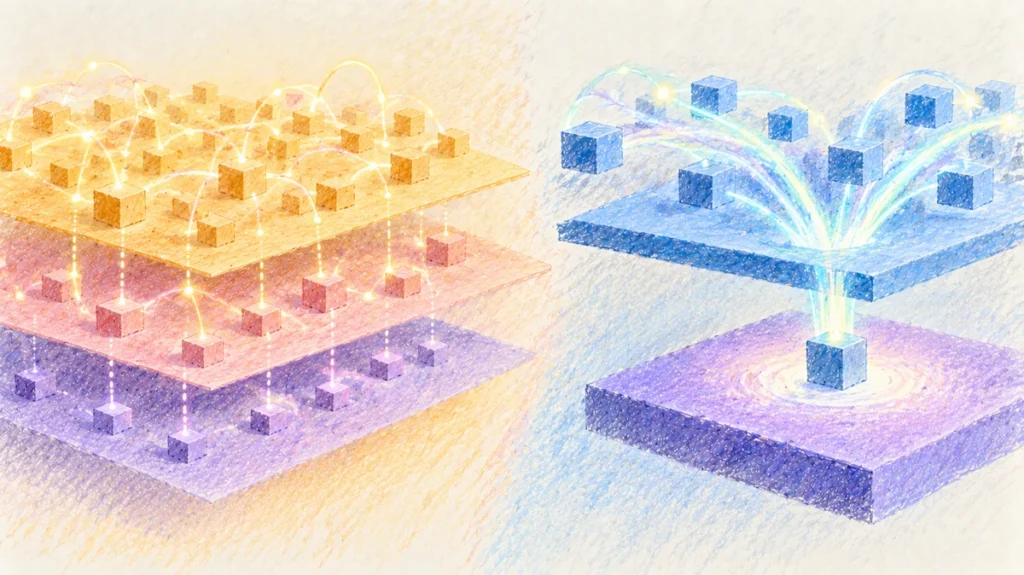
Many people intuitively picture a blockchain block as “a container holding many transactions.” That understanding is not wrong, but it is incomplete. If a block were merely a list of transactions, it would be hard to explain why blockchains are tamper-resistant, why nodes can quickly verify data consistency, and why blocks on different chains look so different.
This article answers a specific question: what parts make up a block, what function does each part serve, and why “a block is not just transactions.”
Breaking Down a Block: Block Header and Transaction List
To understand the internal structure of a block, we can start with an everyday analogy: imagine the blockchain as a ledger, and each block as one page in that ledger. At the top of the page is header information such as the date, the number of the previous page, and a summary of the page’s contents; below that header come the actual ledger entries.
A real block has a similar two-layer structure:
- Block header: stores metadata and handles linking, verification, and consensus.
- Transaction list: stores the user operations or state-change requests that the block actually records.
The “metadata” here is not the transactions themselves but information about the block. It answers questions such as: Which page precedes this one? What do the transactions on this page look like as a whole? When was this page assembled? Does it comply with the network’s consensus rules?
This “metadata + content” structure is key to understanding what is inside a block. The block header is like an ID card and a connector; the transaction list is the actual body of the ledger.
It is worth noting that this analogy has clear limits. A ledger does not automatically lock its pages together through cryptography, whereas hash links in a blockchain are cryptographically strong bindings that do not rely on manual checking. The analogy helps build an intuition for the two-layer structure, but it does not replace the explanation of the mechanisms that follows.
The Block Header: ID and Connector for the Page
A block header usually contains several types of key fields. The following uses Bitcoin’s block header structure as an example to show a simplified view. This is not a universal template for all blockchains, but it helps us see what each block header field does.
A simplified Bitcoin block header typically contains:
- Version number
- Previous block hash
- Merkle root
- Timestamp
- Difficulty target
- Nonce
These fields may look scattered, but they can be understood in three functional groups: linking, verification, and consensus.
Parent Hash: Pointing the Current Block to the Previous One
The previous block hash records the hash of the previous block. A hash function maps arbitrary data to a fixed-length fingerprint; the same data produces the same fingerprint, and any change to the data changes the fingerprint.
The purpose of the previous block hash is to let the current block “remember” the fingerprint of the previous block. In this way, each block points to the one before it, forming a chain that runs backward. If the contents of the previous block are altered, its hash changes, and the previous block hash recorded in the current block no longer matches. This chain of references is one of the foundations of blockchain tamper resistance.
Merkle Root: Compressing a Set of Transactions into One Fingerprint
A block header does not list all transactions directly; instead, it contains a Merkle root. The Merkle root is a single root hash obtained by hashing the transaction list layer by layer through a specific structure.
Its key role is to represent the entire set of transactions with one small fingerprint. If any transaction in the transaction list changes, the Merkle root changes with it. This allows the block header to bind the integrity of the transaction list without storing every transaction again in the header.
There is no need here to go deep into the full construction of a Merkle tree or the process of generating proofs. For understanding a block’s internal structure, it is enough to know that the Merkle root is the “condensed representative” of the transaction list within the block header.
Timestamps, Difficulty, and Nonce: Serving Consensus
The timestamp records the approximate time when the block was assembled, but different chains have different validation rules for time precision and acceptable ranges; the rules of one chain should not be treated as a universal standard.
In proof-of-work (PoW) chains such as Bitcoin, the block header also contains a difficulty target and a nonce. Miners must find a nonce such that the hash of the block header meets the current difficulty target. The nonce is essentially a variable that miners can try repeatedly, while the difficulty target defines “how hard is hard enough.” These two fields serve mining proofs and consensus validation, not the recording of user transactions.
It should be emphasized that the nonce and difficulty target are designs specific to a particular consensus mechanism. Chains using other consensus mechanisms may have completely different fields. For example, after Ethereum’s transition to proof of stake (PoS), its block structure changed. It no longer relies on traditional nonce mining as Bitcoin does, and its block header also includes a state root, transactions root, receipts root, and gas-related fields. Ethereum’s specific fields evolve with protocol versions; for accurate details, consult its protocol documentation.
Here, the state root is mentioned only as background: some chains need to include a summary of on-chain state in the block header to verify state consistency. The detailed construction of the state tree is beyond the scope of this article.
The Transaction List: The Events a Block Actually Records
The transaction list is the content portion of a block. Transactions represent user-initiated operations, such as transfers, smart contract calls, or more generally, a request to change on-chain state.
A block usually packages multiple transactions rather than giving each transaction its own block. The benefit is greater throughput efficiency: grouping multiple operations on one page is more economical than giving each operation its own page. Chains may define transaction contents, ordering, and execution differently, but “a block contains a set of transactions” is common to most chains.
The transaction list and the block header are bound through the Merkle root. Imagine a simplified scenario: a block packages three transactions, Tx1, Tx2, and Tx3. After layer-by-layer hashing, they produce a Merkle root, denoted R. This R is written into the block header. If any one of the transactions is altered, the recalculated root becomes R′, which does not match the R recorded in the block header.
This explains why the block header, although it is not the transaction content itself, helps the network verify that the transaction list has not been tampered with.
How the Block Hash Binds Transactions and the Chain Together
Now we can answer a key question: why does changing a transaction in a block cause problems for the chain that follows?
This requires understanding the relationship among three components: the block hash, the Merkle root, and the previous block hash.
The Block Hash Is a Hash of the Block Header
In chains such as Bitcoin, the block hash is typically an identifier obtained by hashing the block header, not by hashing the transaction list directly. This detail matters because it means transactions affect the block hash indirectly.
The transaction list is first compressed into a fingerprint through the Merkle root and written into the block header; then the entire block header is hashed to produce the block hash. So a change in transactions first changes the Merkle root and then the block hash. The causal direction is: transactions → Merkle root → block header → block hash.
If the causal direction is reversed—believing that “the block hash is calculated directly from transaction contents”—the roles of other fields in the block header are omitted, and the chain relationship through previous block hashes cannot be explained accurately.
Previous Block Hashes Make Chain-Level Tamper Resistance Work
The block header of every block records the hash of the previous block. Suppose an attacker modifies a transaction in block 9. This change alters the Merkle root of that block, which in turn changes the block hash of block 9. The block header of block 10 records the original hash of block 9 as its previous block hash, which now no longer matches. To keep block 10 valid, the attacker must change block 10’s previous block hash, which changes block 10’s hash and then affects block 11, and so on.
This is the effect of chain binding: the earlier the change, the more subsequent blocks must be recalculated.
Immutability Is Computational, Not Absolute
Here we need to correct a common but overly absolute claim: that blockchain contents are “absolutely immutable.”
A more accurate statement is this: tampering breaks the matching of previous block hashes and Merkle roots in subsequent blocks, so it is easily detected by nodes; however, under some consensus mechanisms, if an attacker controls enough computing power, a chain reorganization can still occur. Blockchain immutability is therefore better described as computational and probabilistic tamper resistance, not a logical impossibility of change. Understanding this point is necessary for having reasonable expectations about blockchain security boundaries.
Different Blockchains, Different Block Contents
A common misunderstanding is that all blockchains have the same block structure. In reality, block fields can differ greatly from one chain to another.
Bitcoin and Ethereum, for example, have different block header fields. Bitcoin’s block header is relatively lean and includes fields such as the version number, previous block hash, Merkle root, timestamp, difficulty target, and nonce. Ethereum’s block header includes the previous block hash, state root, transactions root, receipts root, gas-related fields, and timestamp, among others; its block structure also changed after The Merge, and it no longer relies on a traditional PoW nonce.
Even when chains adopt a similar “block header + transaction list” concept, they may define transaction ordering, execution, and state recording differently. Some chains may use different data structures, but most still keep a similar two-layer division.
To understand the block structure of a specific chain accurately, consult that chain’s protocol documentation rather than treating one chain’s field list as a universal template for all blockchains.
Quick Recap: A Complete Mental Model of a Block
At this point, we can distill the internal structure of a block into a memorable model:
- A block = block header + transaction list. A block is not merely a collection of transactions.
- The block header is metadata. It links to the previous block, binds transaction integrity, and participates in consensus validation.
- The transaction list is the content. It records user operations or state-change requests, and a block usually packages multiple transactions.
- The Merkle root connects the transaction list and the block header. Any change in transactions changes the Merkle root and thereby indirectly changes the block hash.
- The previous block hash connects the current block and the previous block. It makes tampering easy to expose and creates a chain-level tamper-resistant structure.
- The block hash is usually a hash of the block header. Transactions affect the block hash indirectly through the Merkle root.
- Specific fields vary by chain, especially between PoW and PoS chains. One chain’s design should not be treated as the universal structure of all blockchains.
If you remember only one sentence: the block header handles “linking and verification,” the transaction list handles “recording content,” and the Merkle root and previous block hash bind these two layers and the entire chain together. Once you understand this structure, when you look at block explorer pages for different chains, you will be able to tell which fields are metadata and which are actual transactions—and you will no longer mistake a block for nothing more than a transaction list.